
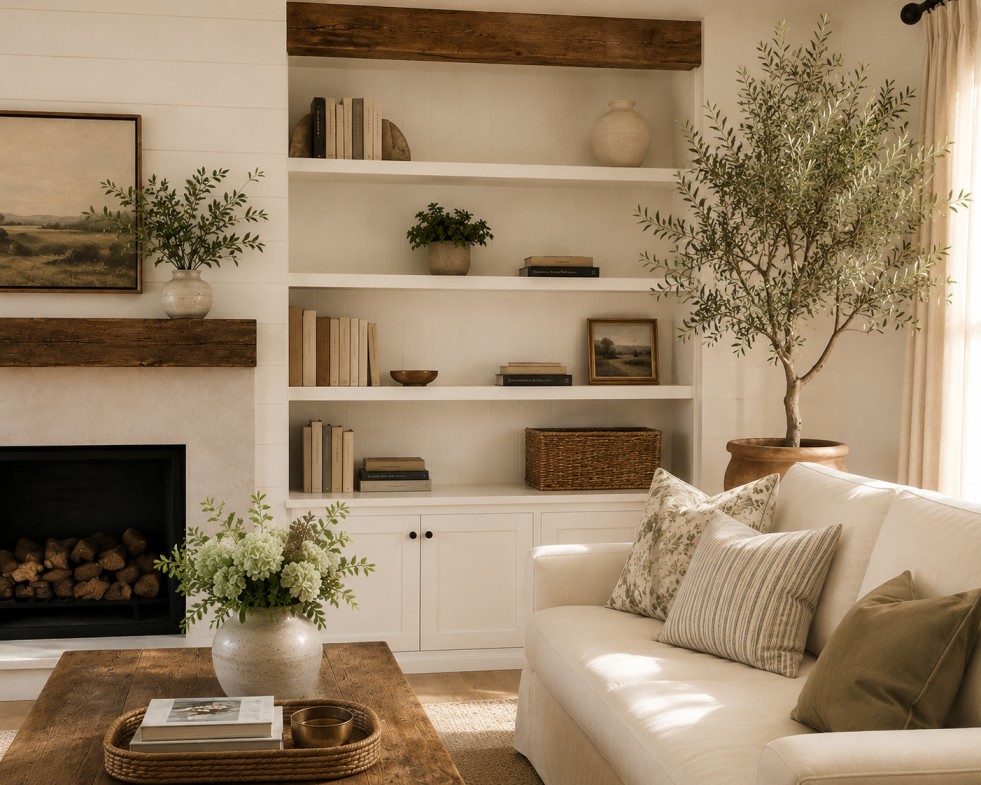

The most common mistakes when decorating a farmhouse living room include: buying furniture that is too small for the space, using too many shiplap features at once, choosing all-beige color palettes with no contrast, mixing too many competing textures, ignoring proper rug sizing, over-decorating open shelves, buying fake distressed items instead of real aged pieces, and skipping proper lighting layers. Each mistake makes the room feel either chaotic or flat — neither of which is what farmhouse style is meant to deliver.
Farmhouse living rooms look effortless in photos.

But getting there is actually harder than it looks. Most people make the same mistakes. They do not know they are making them until the room feels “off” — and they cannot explain why.
The biggest farmhouse decorating mistakes are not about buying wrong things. They are about using the right things in the wrong way. Too much of one texture. Furniture that is too small. Beige in every corner. These quiet errors kill the look before it starts.
This guide names every common mistake clearly — and gives you the exact fix for each one. No guessing. No vague advice. Just honest, direct answers that actually change how your room looks.
Furniture Mistakes
Mistake 01 – Buying Furniture That Is Too Small
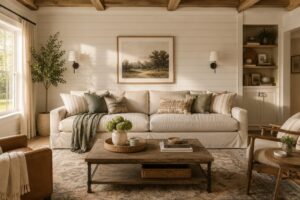
This is the number one farmhouse living room mistake. A small sofa in a large room looks like furniture that does not belong there. It creates dead space on both sides. The room feels empty even when it is furnished. Farmhouse style is about filling space with warmth — not leaving it hollow.
The rule is simple. Your sofa should span at least two-thirds the width of the wall it faces. In a 15-foot-wide room, that means a sofa no shorter than 90 inches. If the sofa feels too big in the store — it is probably right for the room.
Mistake 02 – The Rug Is Way Too Small
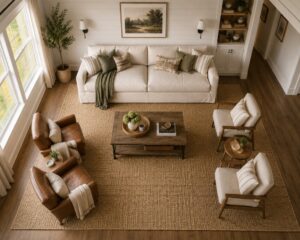
Mistake 03 – No Coffee Table — or the Wrong One
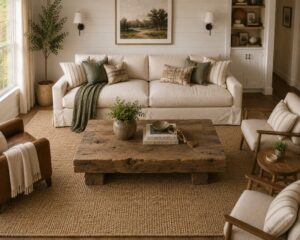
The “floating furniture” problem: If every piece of furniture in your farmhouse living room is pushed against a wall, the room has no conversation zone. Farmhouse style is built around gathering. Pull the sofa 18–24 inches away from the wall. Let it anchor the center of the room. Furniture against walls is a waiting room. Furniture facing each other is a living room.
Mistake 04 – The All-Beige Farmhouse Room
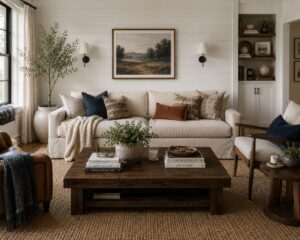
Farmhouse style is often associated with neutral tones. So people paint everything beige, buy a beige sofa, add beige pillows, and put a beige rug down. The result is a room that looks like a showroom model unit — sterile and unoccupied.
Farmhouse style needs contrast. Not dramatic color. But intentional contrast. One navy throw pillow does more for a beige sofa than five beige ones. A dark-stained wood coffee table does more for a cream living room than a light one. A single sage-green plant does more than a dozen beige accessories. The neutral base is not the whole room. It is the canvas.
Mistake 05 – Shiplap on Every Single Wall

Mistake 06 – Too Many Competing Textures at Once
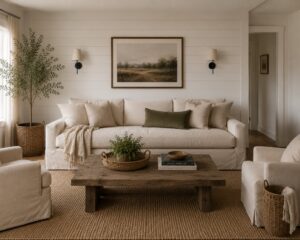
The Farmhouse Color System — Done Right
Three roles. Every color earns its place.
Mistake 07 – Buying Fake Distressed Items

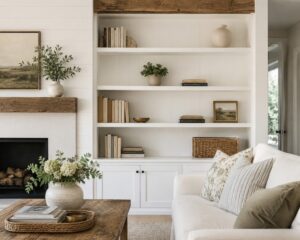
Mistake 08 – Over-Decorating Open Shelves
Mistake 09 – Curtains That Stop at the Window
Mistake 10 – Only One Overhead Light Source

The lamp test: Walk into your farmhouse living room at 8 PM. Turn off every overhead light. Turn on every lamp. If the room looks better — you have the right lamps in the right places. If the room looks dark and depressing — you need more lamps, not brighter bulbs. More light sources at lower wattage always beats one bright ceiling light. This is the single fastest way to fix a farmhouse room that feels flat.
Mistake 11 – No Living Plants in the Room

Mistake 12 – Gallery Wall with No System

12 Rules That Fix Every Mistake on This List
- Each rule undoes one specific error. No overlap. No vague advice.
- Sofa = at least ⅔ the width of the wall it faces
- Fixes the floating furniture problem immediately. Non-negotiable.
- Rug front legs rule — all front legs of every seating piece on the rug
- Connects the seating group. Makes the floor an intentional zone.
- Coffee table = reclaimed wood, stone, or woven — never glass, never chrome
- Glass breaks the farmhouse material language in one piece.
- 60% neutral + 30% warm wood + 10% deep contrast color
- The ratio that prevents both the all-beige problem and the chaotic color problem.
- Shiplap: one wall maximum. Two walls only in rooms over 300 sq ft
- One wall is an accent. Four walls is a crate.
- Three textures max — one dominant, one secondary, one accent
Beyond three, the room stops reading as curated and starts reading as collected.
One genuinely old piece per room. Everything else can be new
Authenticity is contagious. One real thing makes adjacent new things believable.
Open shelves: 60% full. 40% intentional negative space
Empty shelf space is a design decision, not a sign of incompletion.
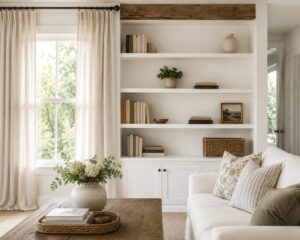
Curtain rod = 4–6 inches above window frame. Curtains = floor length
This trick makes ceilings feel 2 feet taller. No renovation required.
Three light sources minimum — overhead off after 7 PM
Lamps at 40% brightness feel warmer than a ceiling light at 100%.
One large plant. Corner placement. At least 4 feet tall
Height in a corner completes the room’s vertical composition. Nothing else does this cheaply.
Gallery wall: one frame color. Three-inch spacing. Consistent rule
Consistent gaps make diverse content look like a collection, not a collage.
The honest truth about farmhouse decorating mistakes: Most of them are not about buying the wrong thing. They are about not understanding the system behind the style. Farmhouse design is not random. It has rules about scale, contrast, texture hierarchy, and lighting that most decorating guides never explain. Once you know the rules — you can break them deliberately. Until then, follow them exactly. The room will tell you when it is right.